
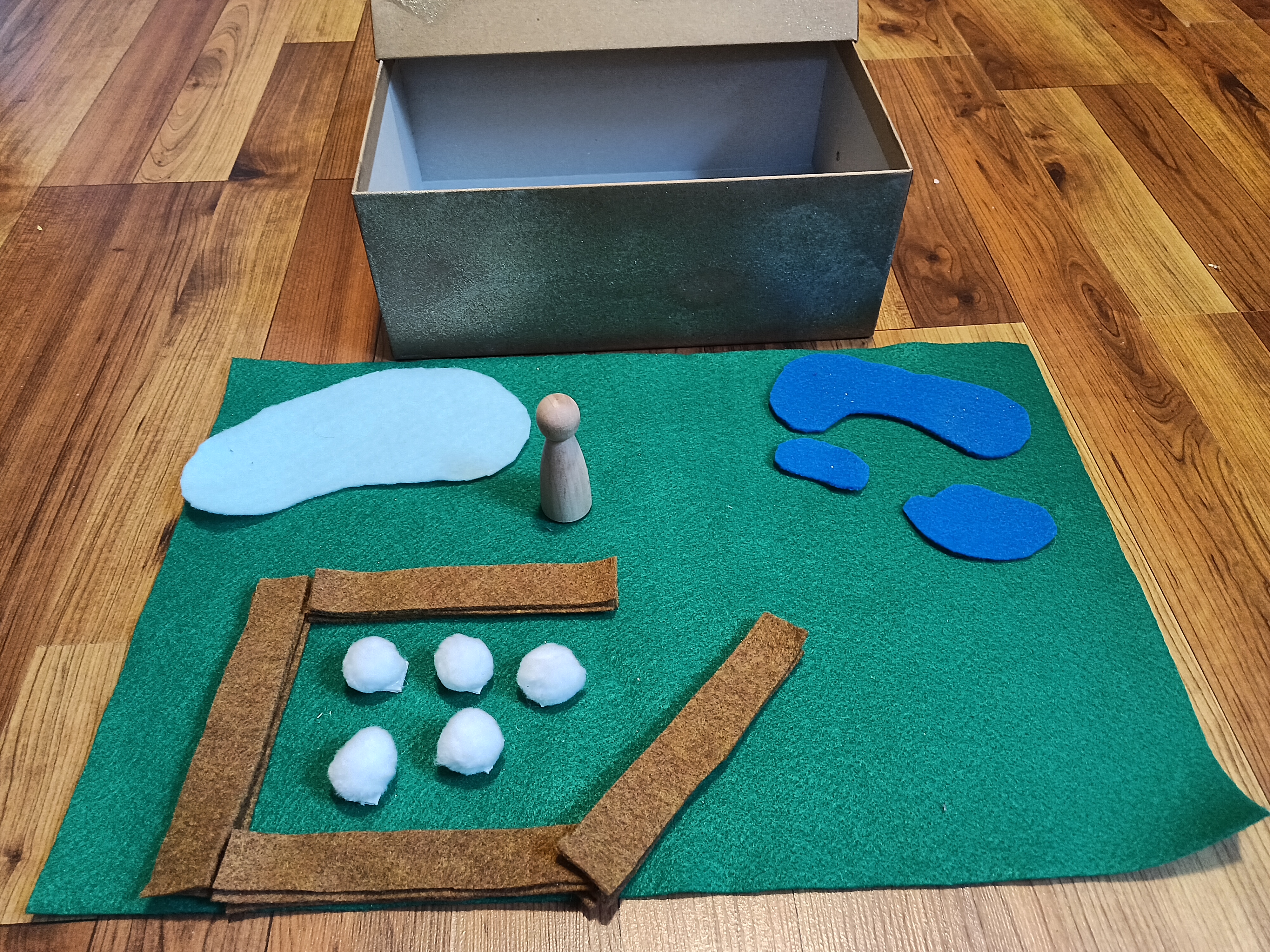
So I found another Godly Play script on the internet- this one is the parable of the Good Shepherd. I went to Michaels to get all my supplies and began memorizing the script. The script was much longer and I found the task to be daunting. It actually took me several weeks. I just had other things coming up and not a lot of quiet time to spend memorizing. I do believe that this could be a spiritual experience for me as well but it may be too daunting to do every week. So I’m thinking about how to maybe stagger the Godly Play weeks. I could fudge it a bit but I found the wording of the script to be powerful and not always intuitive. I don’t want my kids to miss out on an opportunity because I didn’t really “perform” the story correctly.
After finally getting the script for the Good Shepherd down and finding the right moment this Sunday, I embarked on my second Godly Play attempt with revised expectations. I worked hard to be patient as critical parts of the story got interrupted, as I repeated myself on several occasions. Periodically I wondered if they were even hearing the best parts and found myself working hard to refrain from yelling or threatening…I kept working with the frustrated parts of myself and the parts that put a lot of pressure on me to do this right. It actually went pretty smooth but it was hard for my frustration to relax.
They were pretty excited about it, Max in particular seemed to really light up at the idea of doing Children’s Church- we had missed the last two weeks. But I think what was truly rewarding was the prayer time. After they had played with the stories of fifteen minutes (Max played with the Good Shepherd and Maddox played with the story of Jesus welcoming the children) we had a brief time of prayer. Max asked God to hug me and lick my like a lion and Maddox wanted God to play with him. There were some genuinely sweet moments during this time and I continued to see glimpses of Max’s memory regarding our Children’s Church times.
It is hard to put into words the “magic” around seasoned Godly Play “story tellers.” I have spent almost 20 years in the study and training of human nature, growth and healing. During that time I’ve learned different therapeutic modalities and watched countless demonstrations. Over the course of that time you began to pick up on subtle cues that differentiate a novice from an expert even when they use the same words and techniques. What I observed in these seasoned teachers were elements that you can’t find in the script. I think Jerome Berryman does an excellent job describing the process and the inner state of the story teller. In the therapeutic community it is well recognized that what goes on internally for the therapist is just as critical as the interventions done. So part of my self critique involves some of those elements. The story tellers for Godly Play provide a very unique space that invites internal parts of the child to emerge and have an experience that other kinds of teaching does not.
The “wondering” phase is an art form that is integral to the process but not easily done. It takes time to learn the art and science behind engaging children this way- at least that’s the case for me. What I am referring to as the wondering phase is actually a series of “I wonder” questions that can get sprinkled throughout the story but often a majority come at the end. Here are some examples:
I wonder if these sheep have names? · I wonder if the sheep are happy inside this place? · I wonder where this place could really be? · I wonder if you have ever come close to such a place? · I wonder if you have ever found good grass? · I wonder if you have ever had the cool, fresh, clear water touch you? · I wonder if you have ever had to go through a place of danger? · I wonder how you got through? · I wonder if you have ever been lost? · I wonder if you have ever been found? · I wonder if the Good Shepherd has ever called your name? · I wonder where this whole place could really be?
Some of the questions in the scripts are quite sophisticated and deep. They subtly invite and stretch the child’s understanding:
The box is also closed. There is a lid. Maybe there is a parable inside. Sometimes, even if we are ready, we can’t enter a parable. Parables are like that. Sometimes they stay closed. The box looks like a present. Parables were given to you long ago as presents. Even if you don’t know what a parable is, the parable is yours already. You don’t have to take them, or buy them, or get them in any way. They already belong to you.
I’ll try to go into some of the details of Godly Play in some future blogs.

 Raising Gentle Faith