
Godly Play Part 2

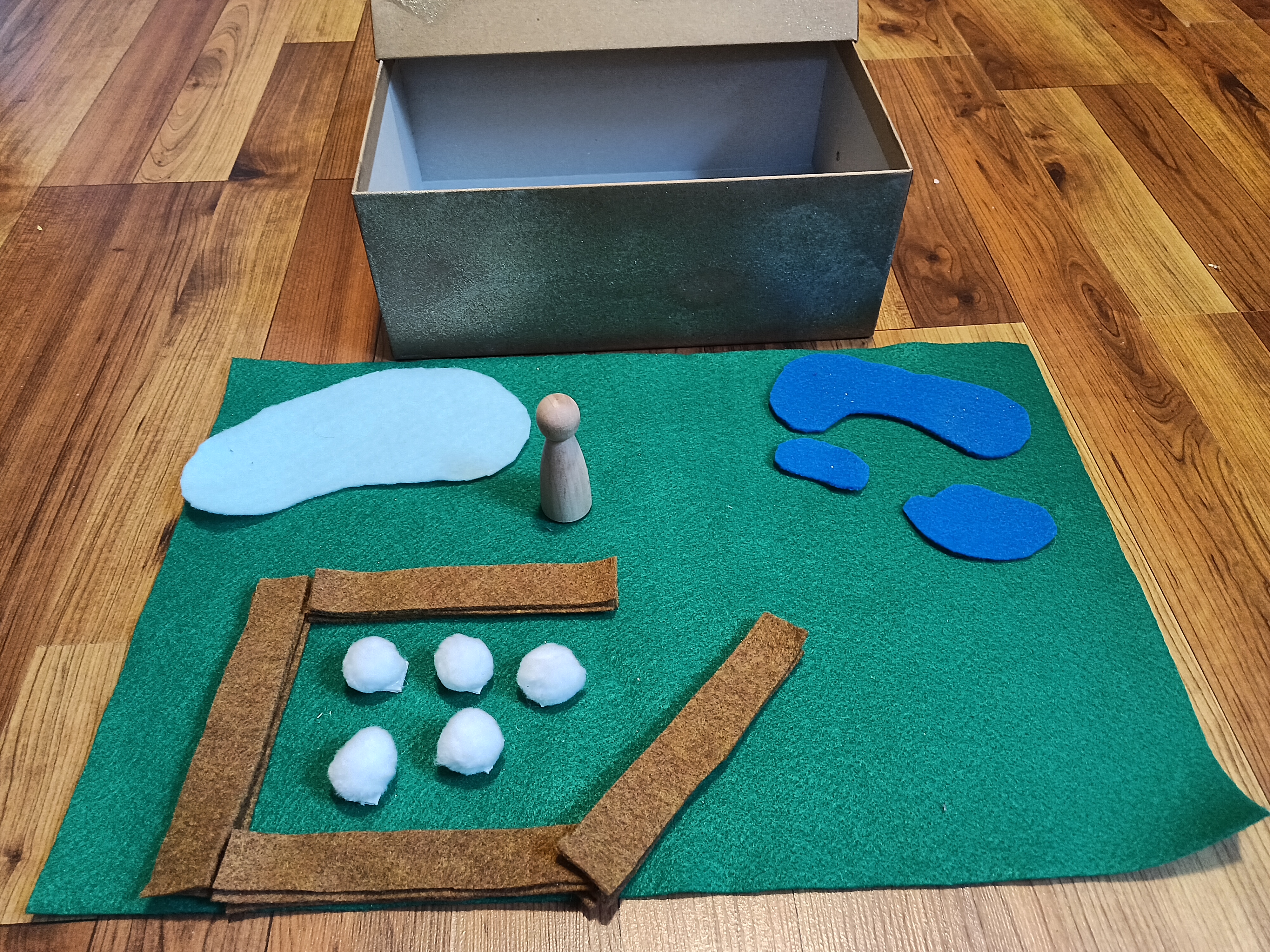
So I found another Godly Play script on the internet- this one is the parable of the Good Shepherd. I went to Michaels to get all my supplies and began memorizing the script. The script was much longer and I found the task to be daunting. It actually took me several weeks. I just had other things coming up and not a lot of quiet time to spend memorizing. I do believe that this could be a spiritual experience for me as well but it may be too daunting to do every week. So I’m thinking about how to maybe stagger the Godly Play weeks. I could fudge it a bit but I found the wording of the script to be powerful and not always intuitive. I don’t want my kids to miss out on an opportunity because I didn’t really “perform” the story correctly.

After finally getting the script for the Good Shepherd down and finding the right moment this Sunday, I embarked on my second Godly Play attempt with revised expectations. I worked hard to be patient as critical parts of the story got interrupted, as I repeated myself on several occasions. Periodically I wondered if they were even hearing the best parts and found myself working hard to refrain from yelling or threatening…I kept working with the frustrated parts of myself and the parts that put a lot of pressure on me to do this right. It actually went pretty smooth but it was hard for my frustration to relax.

They were pretty excited about it, Max in particular seemed to really light up at the idea of doing Children’s Church- we had missed the last two weeks. But I think what was truly rewarding was the prayer time. After they had played with the stories of fifteen minutes (Max played with the Good Shepherd and Maddox played with the story of Jesus welcoming the children) we had a brief time of prayer. Max asked God to hug me and lick my like a lion and Maddox wanted God to play with him. There were some genuinely sweet moments during this time and I continued to see glimpses of Max’s memory regarding our Children’s Church times.

It is hard to put into words the “magic” around seasoned Godly Play “story tellers.” I have spent almost 20 years in the study and training of human nature, growth and healing. During that time I’ve learned different therapeutic modalities and watched countless demonstrations. Over the course of that time you began to pick up on subtle cues that differentiate a novice from an expert even when they use the same words and techniques. What I observed in these seasoned teachers were elements that you can’t find in the script. I think Jerome Berryman does an excellent job describing the process and the inner state of the story teller. In the therapeutic community it is well recognized that what goes on internally for the therapist is just as critical as the interventions done. So part of my self critique involves some of those elements. The story tellers for Godly Play provide a very unique space that invites internal parts of the child to emerge and have an experience that other kinds of teaching does not.

The “wondering” phase is an art form that is integral to the process but not easily done. It takes time to learn the art and science behind engaging children this way- at least that’s the case for me. What I am referring to as the wondering phase is actually a series of “I wonder” questions that can get sprinkled throughout the story but often a majority come at the end. Here are some examples:

I wonder if these sheep have names? · I wonder if the sheep are happy inside this place? · I wonder where this place could really be? · I wonder if you have ever come close to such a place? · I wonder if you have ever found good grass? · I wonder if you have ever had the cool, fresh, clear water touch you? · I wonder if you have ever had to go through a place of danger? · I wonder how you got through? · I wonder if you have ever been lost? · I wonder if you have ever been found? · I wonder if the Good Shepherd has ever called your name? · I wonder where this whole place could really be?

Some of the questions in the scripts are quite sophisticated and deep. They subtly invite and stretch the child’s understanding:

The box is also closed. There is a lid. Maybe there is a parable inside. Sometimes, even if we are ready, we can’t enter a parable. Parables are like that. Sometimes they stay closed. The box looks like a present. Parables were given to you long ago as presents. Even if you don’t know what a parable is, the parable is yours already. You don’t have to take them, or buy them, or get them in any way. They already belong to you.

I’ll try to go into some of the details of Godly Play in some future blogs.  

Godly Play PART 1

A while back when I was sending my plea out to the twitter-verse for ideas about helping my kids discover their worth in God, Jonathan Puddle graciously extended an invitation to talk about this and about possibly adapting his book for use with my children. It was a deeply rewarding conversation. I ended up reading his book, “You Are Enough” and doing his meditations, and found both to be an amazing experience.

Some time later, I was listening to a podcast by Jonathan . He was interviewing Julie Canlis about her book “A Theology of the Ordinary,” and she happened to mention something about Godly Play. She stated that it was invented by Jerome Berryman and it was based upon the Montessori theory of learning, of which I am a big fan.

So I “googled” it to learn a bit more about it. I found a YouTube video of a woman doing the parable of the great pearl (https://youtu.be/h-b3T7HfXYY) and I was mesmerized. The protocol involves memorizing the script which is an adaptation of the parable and use craft materials to enact the story. Afterwards the children are invited to play with the story or any other story that they have done as well as do a craft in response to the story. And at the end there is a little “feast” which would consist of water and crackers.

I decided to show the YouTube video to my oldest son to see if this would be of interest. It was met with mixed review. He didn’t seem to be thrilled with it that much but then he asked the next night to watch it again. It seemed that he would get very engaged and then lose interest. I thought that was enough.

So being me I ordered Berryman’s book and began a search of peer reviewed journal articles to see if any research had been done. I found an excellent article in the International Journal of Children’s Spirituality . Kathy Frady did a study using this method with 2-year-olds in a few church settings. She did the story of how Jesus welcomed the children after his disciples tried to turn them away. Her script was short and included in the journal article, so I decided to use that one as my first Godly Play.

I set up the play room with two mats and I put together the materials for the story. I found a large book shaped box to house it and I found craft supplies (and a rock) to use for the story. It was kind of rewarding to create this visual, reusable story box.

It was a lot of work, memorizing the script and putting the “set” together. I had high expectations based upon what I had read, seen and prepared for. My expectations were way too high! In hindsight it went fine but I was greatly disappointed during it. I’m finding that doing this at home presents some challenges that are less likely in a Church setting with a teacher. I’ll talk more about this in upcoming blogs as I try and work through them. I think there may need to be some adaptations down the road but I’m going to stick with the official protocol for a bit as I learn it’s nuances. There are some deep nuances to the script that I’ll comment on in later posts as well.

Feel free to send you comments, questions or observations. If any of you have some experience with Godly Play I’d love to hear from you.

The boys in the mirror (Wk 9)

I have to say I was pretty excited about Sunday’s lesson. I’m not sure why, but I just thought it was a good follow up to the lessons I’ve been trying to teach the kids about their self worth. I warned my wife in advance about her participation.

Photo by Maksim Goncharenok on Pexels.com

I had my wife draw a picture (she’s a MUCH better artist than me). When the lesson started I was going to compliment the artwork specifically and then crumple it up, but I decided that I didn’t want to model that behavior. Remembering that my oldest really liked Orange and Carrot from the previous lessons I decided to have Orange make a guest appearance and have him do the crumpling. Orange was great because he got both of the kids focused after we watched some song videos. Orange, by the way, is just a tangerine with eyes and a mouth that I drew on it. Obviously, every time orange makes an appearance he is a new orange (the old ones don’t last that long).

So I showed them Mommy’s picture and talked about all the things that I really liked about it. Then Orange came up and crumpled it (I warned my wife in advance that this would happen). They got a kick out of it and after I asked them they were able to articulate why that was wrong. I stretched that part out a bit talking about valuing someone’s artwork and then I brought it back to us.

I brought out a full length mirror and set it up. I looked in the mirror and thanked God for the attributes that I thought he did a great job with. It went something like “Thank you God, you did a great job with my smile.” Then my wife stood in front of the mirror and did the same. We thanked God for physical qualities and internal qualities. I thought both were important because we also have to learn to love and respect our bodies as well as our other attributes.

When it came time for my oldest to do it he kind of clammed up. I really wanted him to say what he thought God did a good job on but I think he might have gotten a little shy. So as my four year old stood in front of the mirror, I held his shoulders looked at the reflection and thanked God for some of his amazing attributes. My wife said that the expression on his face indicated how meaningful it was to him. My two year old got in front of the mirror, put both hands on his chest and said “Maddox!” It was cute. I stepped in and tried to do the same with him as I did with my older son but it was a little more difficult to hold his attention.

I then played the video and I gave each of them hugs telling them “I love my picture!” They seemed to really get a kick out of it. Max and Maddox have made references to the lessons periodically so they seem to be meaningful. I suspect that part of that is because it is a unique time and that I am pulling in some things that are meaningful to them.  I’m still wondering when the well will dry up and I’ll run out of idea.

God Signs His Artwork (Wk 8)

My oldest had asked last week if Children’s church was going to have carrot and orange, so I brought them back this week. After a couple of children’s songs from youtube (This little light of mine, etc..) I brought out carrot and orange and tried to engage my 2 and 4 ½ year old. My oldest kept wanting to grab the orange and play with it but I managed to settle them down a bit. I told them that God writes his name on our hearts. I got a big “WHAT!” from my oldest and my 2 year old just imitated him. It was cute.

I had carrot ask my oldest why he put his name on his artwork and he responded, “So they know that its mine!” Orange responded by asking if he was proud of his artwork and my son smiled while nodding. Carrot explained that God is proud of His artwork and wants everyone to know that you are His art.

Carrot then asked if they remembered how Buzz felt horrible about being a toy until Woody showed him that Andy wrote his name on his foot, that he was special because Andy loved him and he was Andy’s toy (they had seen and read the Toy Story). I told them we were going to do something special and I got out some markers and we wrote God’s name on the bottom of their feet. They really got a kick out of that and wanted both feet, of course! Then we did some art together.

It was cool, felt short to me but probably just right for them. I never really know how well these things go but my wife said it went well. Later that day my oldest son made a reference to God/Lion licking him (a reference to an earlier lesson) and then he began talking about being God’s toy and how he was playing with us. I took this as a good sign that he’s absorbing things. I’m hoping with my youngest that he kind of absorbs these things and grows into them as we continue to do them. The next week my youngest looked at his foot and said “God not there!” and wanted me to write it again.

I am definitely feeling the pressure of coming up with something each week….for the next fifteen years or so?!